Wednesday, December 20, 2023

LILa construction November - December 2023

A lot has been going on at the construction site, which you can also read about more here. Now that it is two months later, you can also see more to get an on-site impression below. We even had snow!


November 1


November 3


November 14


November 16


November 22


December 4


December 12


Tuesday, December 5, 2023

World Soil Day

Today is world soil day. The UN has chosen this moment to consider how soil affects our daily lives.

"Our planet’s survival depends on the precious link between soil and water. Over 95 percent of our food originates from these two fundamental resources. Soil water, vital for nutrient absorption by plants, binds our ecosystems together. This symbiotic relationship is the foundation of our agricultural systems.

However, in the face of climate change and human activity, our soils are being degraded, putting excessive pressure on our water resources. Erosion disrupts the natural balance, reducing water infiltration and availability for all forms of life.

Sustainable soil management practices, such as minimum tillage, crop rotation, organic matter addition, and cover cropping, improve soil health, reduce erosion and pollution, and enhance water infiltration and storage. These practices also preserve soil biodiversity, improve fertility, and contribute to carbon sequestration, playing a crucial role in the fight against climate change.

World Soil Day 2023 (WSD) and its campaign aim to raise awareness of the importance and relationship between soil and water in achieving sustainable and resilient agrifood systems. WSD is a unique global platform that not only celebrates soils but also empowers and engages citizens around the world to improve soil health."

For our Green Panel research we are testing different substrates to grow sedum on: soil, rockwool, and recycled fabric, as well as combinations thereof. So far results were inconclusive whether or not there was a difference in temperature or soil moisture, but now the seasons have changed we might expect more pronounced differences. Temperatures have dropped below 0 and precipitation has increased, and results are about to be analyzed by our new student teams. It may seem that other materials perform well in terms of water and energy resources, or circularity, but ultimately, flourishing vegetation enhances evapotranspiration and biodiversity.

Tuesday, November 21, 2023

Results from Urban Green Infrastructure Walk Shop #4

Today's walk shop was focused around the question of performance. How can we prove how well green infrastructure is performing, how do we know it is giving the benefits we desire? This can be measured by looking at related indicators for each of the benefits. Students of module 10, smart solutions for sustainable cities each took on one topic to design a measurement plan for a type of green infrastructure of their choice. The walk shop route featured different types of GI at our campus where groups had to think about applicable indicators.

During the design phase the premise was as follows: You install a green infrastructure in a place you know to help reduce climate change impacts. Your job is to prove how effective your chosen green infrastructure is.Your theme is the impact you want to reduce. (Themes: energy consumption, extreme temperatures, extreme precipitation, flood peaks, CO2 sequestration).

The groups then had to consider which location to design for, which type of green infrastructure, and which indicator to measure performance with, as well as a sensor and measurement location/frequency appropriate to prove the performance. The solutions were well thought of and students were critical of each others' designs. Each group argued well about the details of their plans.


Friday, November 17, 2023

Further Green Panel research developments

Giulio Zen is a master student from Industrial Design and Engineering, who is further developing the Green Panel design and performance at the University of Twente. As per his description:

The main goal of this master's thesis assignment is to test the effectiveness of the irrigation system design that is going to be integrated in the green roof system. In order to examine the efficacy of the designated materials and of the design itself; a data collection and the subsequent data analysis will be performed. Parallel to that, in order to define all the elements that need to be produced the used manufacturing processes will be analyzed. To minimize the potential risks that could impact the project success a risk assessment will be performed meantime. Along to the above mentioned tests, different other validation phase will take place; such as FEM analysis, molding simulation and functional models. 

Questions? Comments? Contact him at g.zen@student.utwente.nl


Urban Green Infrastructure Walk Shops

How can our experience of the living natural world be a catalyst to rethink the landscape of Twente University Campus?

During this walk-shop we re-imagine human-managed landscapes through playfully exploring ways of reshuffling green infrastructure patterns and rethink rural-urban (rurban) interactions. The walk-shop will be guided by artist Merel Zwarts, from the Travelling Farm Museum of Forgotten Skills, developed in collaboration with the RUrban Futures Collective at BMS and with financial support from UT's Climate Centre.

 Read more and register here.

  • What? Urban Green Infrastructure Walkshop
  • When? November 30th, 10:00-12:30
  • Where? Starting point at DesignLab
  • For who? Anyone interested
  • Registration? Needed, fill out the form

This is a free event hosted by the University of Twente during sustainability week. Check out the entire program here.

Friday, November 10, 2023

National Environmental Day

Today is National Environmental Day. This year the Network of Environmental Professionals who organizes the event has selected the theme of Planetary Justice.

They write: Planetary Justice is an extension of climate justice, in that a just distribution of costs and benefits, historical responsibility and intergenerational justice is sought. This is a challenging concept that needs further reflection and discussion. Not only as a moral concept, but also in a practical sense. What you do here in the Netherlands as a consumer or environmental professional affects the other side of the earth. If you make policy on energy transition or fail to take action, it has consequences for the extraction of materials in countries such as Chilli, China, Congo, and Indonesia. The emissions we cause in the Netherlands or elsewhere increase the likelihood of tipping points, which threaten nature and people worldwide. Planetary justice asks us questions about virtually every habit, choice or intervention not just nationally, but globally. It has in its lens the Earth system as a whole, as well as people, animals and ecosystems.

This is why we seek to develop both green infrastructure and measuring systems, from their entire life cycle, as well as research practices, that have the least environmental impact. More information on the planetary justice framework in general can be found in this publication.

Friday, November 3, 2023

Results from Urban Green Infrastructure Walk Shop #3 Cycle shop

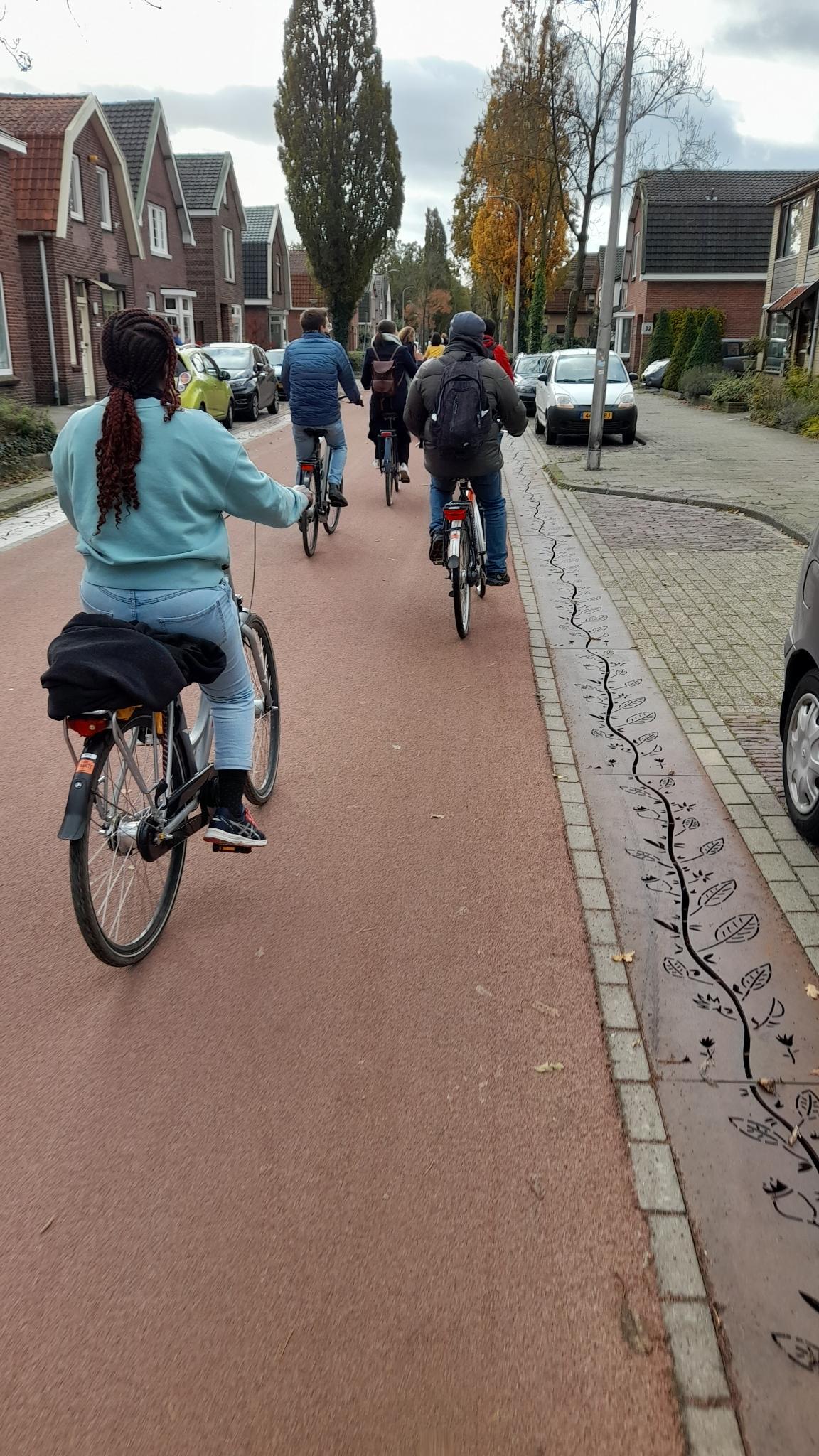
Today we had a cycle shop instead of a walk shop. As part of the NEEDS conference at the University Twente, one of the potential field tours was a cycle shop where Koen Wagelaar from municipality Enschede explained on the way about the different implemented projects. 

We started at the UT with a lecture by Koen, showing among others the different climate labels for areas in Enschede. During the cycle shop, we visited the areas in Ledeboer park, new drainage in the Pijlhovestraat, water retention areas in the Toekomststraat, water retention and permeable parking areas as well as stream restoration in the Rembrandtlaan, the waterpark Pinkeltjesplein, a community garden at the Robsonstraat, and of course the ring road wadi water retention areas, before arriving at city hall and having more Q&As. Participants worked in groups to develop their ideas on how their areas and Enschede could learn from each other, what would work in which area and what wouldn't, and most importantly, why.

For more details, see also my colleague's post on Linked In. And if you want to join a future walk shop, be sure to register for our final event during the Sustainability Week. Impressions of the cycle shop below:


Policy trends in river and flood management in the Netherlands since the 2010s - part 5

This part has a local cas e  studies of spatial management in river areas, showcasing how the different policies translate to implementation...