Showing posts with label plant species. Show all posts

Tuesday, April 21, 2026

Earth Day

Today is international Earth Day and the main question is, how is this different from Earth Overshoot Day? Earth Day is held on the same day every year since 1970 and is intended to show support for environmental protection. Earth Overshoot Day varies annually as it depends on when each country, or the entire planet on average, uses up its available resources for the year. It can be around the same time, but we hope earth overshoot day will be later and later in subsequent years. 

While the international website does not show activities for the Netherlands, there is a separate Dutch website with activities. And these are year round. For Earth Day there is a festival, a tree planting event, music in gardens and much more. A good time to remember that we owe our lives to the sun, 15 cm of top soil and the fact that it rains sometimes. 

22 april: dag van de aarde 


Friday, February 20, 2026

GI example - trees and the question: Which tree has the most benefits? part 2

In a previous post we saw the various aspects of trees to take into account to see what category it is. Now that we have some idea of the different types of trees, let's dive deeper into how benefits are calculated. A major player in the Netherlands is i-Tree who published a guide on calculating tree benefits with a great visual example of the extent that larger trees are performing compared to smaller trees. One example shows a chestnut with the circumference of 169 smaller trees combined.


Once you know the tree specifics, you can calculate benefits. These include air pollution removal, CO2 sequestration, food provisioning, oxygen production, stream flow and water quality improvement, volatile organic compounds removal, mitigating UV radiation, and providing wildlife habitat. Other benefits are still in development since the calculations are more complex, such as human health benefits. Details are described in the guide here. 

How this is converted to financial gains is a bit of a mystery, mostly because prices vary from year to year, and sometimes policymakers prefer to rely on actual benefits rather than prevented costs. You can test this on a small scale, once for free, with this software. The WUR also has a guide that you can fill out yourself, depending on the species of tree. Note that this guide is not dependent on a tree's benefits! So it is still difficult to look at an individual tree and go, that's x euro of ecosystem services. Luckily there has been a study testing individual trees and the i-Tree method. This shows a big difference in annual tree benefits in US dollars depending on size (small trees - height less than 7 m with crown diameter < 5 m; medium trees - height 8–15 m, crown diameter 6–10 m; large trees - height over 15 m and crown diameter > 10 m.)


The first two trees below would provide services that are about 3-4 dollars worth every year, and the next two are about medium sized for canopy and could be 14-19 dollars. It seems a low amount given the costs to grow and place a tree, and the wide amount of services they provide and issues they help prevent. Or, much like water and sunlight, we might not value these services that we get for 'free' as much as they should be.


Friday, May 9, 2025

GI example - trees and the question: Which tree has the most benefits?

We saw previously that larger trees planted in an environment with space for their roots and infiltration options can have 2-5 more benefits in terms of shade and heat reduction than larger trees planted in paved environments with little space for their roots. But there are other factors than environment to consider when categorizing trees in how many ecosystem services they can provide. 

The first factor is the life phase a tree is in. Obviously older usually means larger and therefore more leaves and roots, and thus more capable to generate shade, create a habitat for other species, capture and retain water, filtrate air particles etc. A basic life phase overview starts from seedling to young tree, then an adult tree, and finally an old tree that might partially decay. When these phases change will depend on the species of tree, a second factor to consider. At some point the sap in a tree will not travel further up and the growth and structure of the tree will change.  An oak tree could reach 1000 years of age, whereas birch trees struggle to reach 100. Getting an oak tree to become a yound adult would take around 300 years, meaning we have to rethink timelines of when we want which benefits to exist.
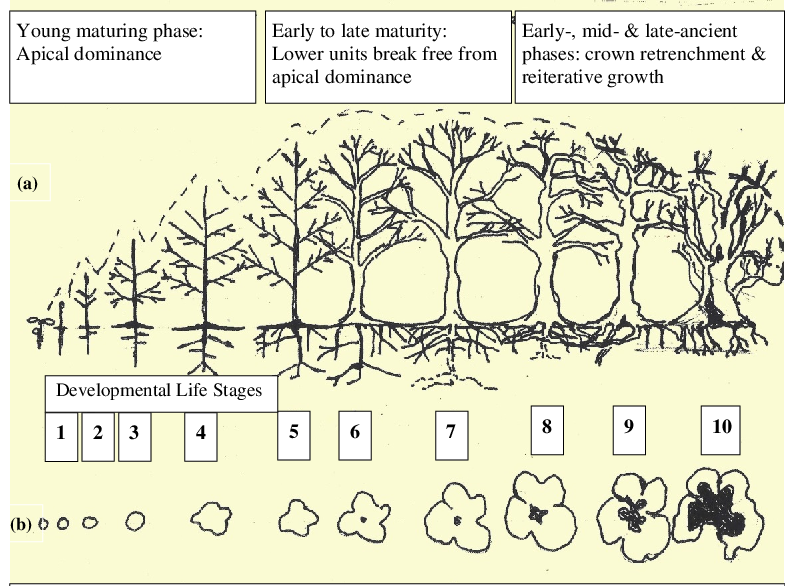
An adult tree is referred to as a category 1 tree. In a webinar from Stadswerk  Marcel Steegh from SoilManias quantified the difference in benefits from a category 1 tree of 50-100 years old as 3000 times that of a young planted tree, which is a dramatic difference. It is definitely worthwhile to have a category 1 tree. One way to grade this is according to the norm NEN 2767, which rates trees higher in their adult phases and lower at their life start and end phases, with a total of 6 categories.

Each species will have a different age for their life phase, and this also comes with different sizes, another factor to consider when planning for certain benefits. Here you can find an overview of how tall each species can become under optimal conditions. Alder trees for instance become 10-35m tall, whereas the large leaved linden can become 30-40 m tall, which will impact most directly where shadows will be.

To help protect older trees we have a list of monument trees with over 15,000 entries of trees that are over 100 years old and have a special local significance. To judge how old a tree might be and if it already fits the criteria for being an adult tree, you can use this guide to estimate the age by measuring the circumference of the tree at 1.30m height, even on slopes. By combining this with the species, you can estimate the crown height and thereby derive what benefits we might experience from each individual tree. 

It is crucial to protect the older trees we have, and equally important to keep planting new trees while simultaneously ensuring they have the right circumstances to grow to maturity and provide more of the benefits we need to survive our changing climate. That would be the final factor to consider, to make sure any new species we select will withstand as much as possible the changes we expect the coming decades, if not longer, given the lifetime expectancy of the species. 


Thursday, April 17, 2025

National climate expo

Two days of national climate expo in Houten. I visited only the second day due to teaching. 

This was a great chance to learn more about research developments on urban heat and green infrastructure through the various sessions (in Dutch), as well as to meet potential organizations to develop new MSc theses projects with. And of course to see our current collaborators from Dakbloemenweide.


From the first session I learned that on average greenery leads to 30-50% of cooling in cities and a drop of 3 degrees Celsius of the Urban Heat Island effect. The type of green, the species, size, amount, and surroundings greatly impact this capacity. A tree with full access to the subsurface can cool 5 times as much as a tree planted directly surrounded by pavement. There was a new guidebook showing for the current common species how effective they are in our current weather, which is most suited for high precipitation, heat, and drought. More info here.


Another session by WUR researchers showed that when making appartment complexes more sustainable, a third of complicating issues had to do with heat and the surfaces surrounding the buildings. There is still a lot we can change by futureproofing these types of houses. It also had results of interviews of how people view and use their garden. Some people don't have any space or any time to use what they have, or purely want it as extension from their hourse, whereas others are more nature oriented and prefer to be heavily involved in managing every plant. Others still let nature run its course and intervene little. This is something to take into account when designing green spaces, to allow for various degrees of interaction and use. More info here.


It was good to see different municipalities having an integrated approach to greening urban areas, and very recognizable to see the difficulties they must overcome in relating needs of greenery to people from other knowledge fields. People still often think trees can be put anywhere, but forget about the subsurface space required, which is at least as much beneath the ground as above ground.


UT Field Lab Roof update July - September 2026

These months we had some extremes in terms of drought but also in terms of short intense rainfall, and it remains rather obvious visually wh...