Showing posts with label life cycle analysis. Show all posts

Wednesday, September 9, 2026

Student research results - Sustainable bike tunnel design

In a novel comparison, one of our BSc students used sustainable design of skyscrapers to rethink how bicycle tunnels in the Netherlands are constructed. Not only could this approach save money, but it can also determine how to save materials, use less concrete and thereby less emissions, or compare alternative materials. Different shapes of tunnels could allow for different weight distribution depending on the material types. You may assume this is already done automatically, and for standard designs this may be the case. However, for this case a partially open tunnel underneath a roundabout was designed, which is more common in a country like the Netherlands. Having an open roof changes the distribution of forces from a standard design. The link to the full thesis in the repository is here and the abstract can be found below.


Abstract

More and more bike tunnels are being developed in the Netherlands due to the rise in population numbers. Bike tunnels often provide safe road crossing for pedestrians and cyclists, promoting uninterrupted traffic flow. However, conventional bike tunnel designs are expensive and carbon-intensive due to the extensive use of overly designed concrete structures. Meanwhile, in the tall buildings sectors, many structural and sustainable innovations have been made. These innovations led to many modern buildings being created that are material efficient and climate resilient.

This research project started by investigating some of the most representative structural and sustainable developments in the recent decades. The follow-up of the investigation resulted in the creation of two structural design prototypes, specifically developed for a bike tunnel project in the Municipality of Ommen. The first prototype implements a topology optimization to structural members. The second prototype deploys a multi-functional centred V-brace system. Both of these prototypes had in focus two sustainable design elements: a composed concrete-timber floor and an open-air design. With the use of Dynamo, a parametric design automation program, the designs were modelled in Revit and transferred to Robot Structural Analysis for structural verification. While the first prototype is structurally not feasible, the second prototype successfully passes the Eurocode verification.

By using IBIS voor Infra and DuboCalc, prototype two is further evaluated for material costs and environmental impact. The evaluation returns a promising cost efficiency result and a significant reduction in environmental impact. The implementation of this type of multi-functional structural systems could sufficiently reduce structural material usage, when compared to conventional single-purposed structural systems. The results also suggest a 1+1>2 relationship between structural and sustainable optimization. While the first prototype is unfeasible, its modelling process sheds some light on how topology optimization could be realistically applied in practice.

Overall, this research project is proposing a promising structural system solution for future bike tunnels. At the same time, it provides insights on how project costs and environmental impact can be reduced by using parametric modelling automation during the design phase, and topology optimization in the manufacturing phase. This proposed approach can prove useful to future projects, and can further enrich the industry.


Wednesday, March 11, 2026

KIEM MV Event for blue-green roofs and solar panels

We are having another KIEM MV event regarding our research on blue-green roofs and solar panels, this time in the botanical garden in Amsterdam. The only drawback is that the event is in Dutch. Hope to see you there!

 Invitation:

Tijdens de Week van de Circulaire Economie nodigen wij je graag uit voor een inspirerende bijeenkomst over de toekomst van het Nederlandse daklandschap op 19 maart, genaamd Groene daken met zonnepanelen, haalbaar en schaalbaar?

 Klik hier om aan te melden!

 Waarom deze bijeenkomst?

Veel stedelijke daken zijn nog steeds donkere, ongebruikte oppervlakken die bijdragen aan hittestress. Door groene daken te combineren met zonnepanelen kunnen we zorgen voor:

 • Meer biodiversiteit  

• Duurzame energieopwekking  

• Een klimaatbestendige stad

Tijdens deze bijeenkomst presenteren de Vrije Universiteit Amsterdam, Dakbloemenweide en Universiteit Twente de resultaten van een praktijkgericht onderzoeksproject naar circulaire groene daken met zonnepanelen.

Wat krijg je mee?

Voorbeeld mini-ecowandeling voor jezelf of (zakelijke) contacten

Canvas voor regeneratief bedrijfsmodel

Na de bijeenkomst: projectresultaten

• Netwerkgelegenheid

 Locatie: 

Botanische Tuin Amsterdam Zuid  

Van der Boechorststraat 8  

1081 BT Amsterdam  

 Programma:

09:00 – Inloop met koffie en thee  

09:45 – Introductie: Het project Integraal Duurzame Daken  

10:00 – Onderwijsresultaten: Minibosbad  

10:15 – Onderzoeksresultaten: Business Model Canvas  

 10:30 – Rondetafelsessies

·                Nieuwe gebouwen en de schaalbaarheid van duurzame daken  

·                Bestaande gebouwen en de haalbaarheid van duurzame daken  

 11:15 – Plenaire terugkoppeling  

11:30 – Borrel en snacks

 Voor wie?

Ondernemers, beleidsmedewerkers, onderzoekers, docenten en gebouweigenaren die willen meedenken over de transformatie van het Nederlandse daklandschap.

Als je nog mensen kent die graag willen weten wat we rond het experimentele circulaire groendak + zonnepanelen hebben gedaan, dan mag je hen uiteraard uitnodigen. Dat kan met deze mail, of door deze LI post te delen: https://www.linkedin.com/posts/katinkaquintelier_weekvandece-circulaireeconomie-activity-7435979158784114688-K11H?utm_source=share&utm_medium=member_desktop&rcm=ACoAAAGnGBwBsMVQXDf-R8ig3zHG7BaU2AWA1uc

 TGV metlogo's 


Monday, November 18, 2024

European week for waste reduction

This entire week from 16-24 November it is the European week for waste reduction, which also has a Dutch website.The aim is to encourage all Europeans make others aware of renewable sources and recycling options. 

While the one entry listed for the Netherlands is a clothing swap in The Hague, our own campus also regularly has clothing swaps, the latest during the sustainability week

As for awareness, I still think the best publication with options along the entire supply chain was: Circular Economy 3.0 - Solving confusion around new conceptions of circularity by synthesising and re-organising the 3R's concept into a 10R hierarchy.This shows the following ten options, and the first 4 (R0-R3) and R7 are specifically for consumers to consider, and can really help with rethinking choices for circularity in our own lives.

R0 = Refuse

R1 = Reduce

R2 = Resell, Reuse

R3 = Repair

R4 = Refurbish

R5 = Remanufacture

R6 = Re-purpose

R7 = Recycle materials

R8 = Recover energy

R9 = Re-mine


Friday, February 2, 2024

Warm Sweater Day

Today it is Warm Sweater Day in the Netherlands, where we are all encouraged to wear more clothes and turn the heating down. I have a lot of thoughts about this, as we try to live as sustainably and circular as possible, this does make a noticable difference, also for our energy expenses. I already practice this daily and wear at least five layers in winter, so there is not more I can do to improve this.

In the end, if we use less heating, this reduces our resource consumption and it has a positive effect on the environment overall. This has an offset of course by having to wash more clothes, which also costs energy, water, and detergent. If you check your energy use you can easily see that heating a space on average will outweigh the costs of additional washing by a factor of 4-10, at least for the direct energy consumption. From a life cycle perspective, it does not include the energy needed to treat and pump the water to the washing machine, or to produce and transport the detergent. I still estimate those costs totalled would be less than increased heating.

An additional consideration is, in winter, how low can you go, and in summer vice versa if you were to wear less and not use cooling, how high can you go, while still being healthy? For several groups of potentially vulnerable people, such as older adults, children, pregnant people, and people with certain medical conditions, the temperatures cannot be too low or high, or medical conditions arise. These groups of people have a smaller acceptable temperature margin than the average population. This means that even if we use more sweaters, there is a limit. What is it?

This website selling airconditioning mentions research from the Technical University in Helsinki and the Lawrence Berkeley National Laboratory. It says for work the ideal temperature is 21-22 degrees Celsius; bathrooms 22-24, adult bedrooms 16-19 and child bedrooms 17-20. Indoor temperatures less than 16 degrees can lead to molds and asthma. Less than 12 degrees can impact the cardiovasculair system. Cold indoor temperatures can increase depression, confusion, decrease concentration, and increase chronic pain. Heat can lead to headaches, fatigue, and less concentration. The online manual VHG Het Levende Gebouw (The living building) also states that every degree over 25 and under 20 leads to a drop of 2% in productivity. This seems to be an ideal range for the average population.

We could keep our indoor temperatures around 18 degrees if we manage to dress more warmly. But this still has to be balanced with activity, to even out how warm you feel inside. We know it is healthier to not sit down for hours on end without moving, and the positive benefits of a walk, especially in nature, are proven as well. So yes, wear more sweaters to save on heating, but also move your body regularly, about every hour, and get a cup of hot water/hot drink.


Friday, November 10, 2023

National Environmental Day

Today is National Environmental Day. This year the Network of Environmental Professionals who organizes the event has selected the theme of Planetary Justice.

They write: Planetary Justice is an extension of climate justice, in that a just distribution of costs and benefits, historical responsibility and intergenerational justice is sought. This is a challenging concept that needs further reflection and discussion. Not only as a moral concept, but also in a practical sense. What you do here in the Netherlands as a consumer or environmental professional affects the other side of the earth. If you make policy on energy transition or fail to take action, it has consequences for the extraction of materials in countries such as Chilli, China, Congo, and Indonesia. The emissions we cause in the Netherlands or elsewhere increase the likelihood of tipping points, which threaten nature and people worldwide. Planetary justice asks us questions about virtually every habit, choice or intervention not just nationally, but globally. It has in its lens the Earth system as a whole, as well as people, animals and ecosystems.

This is why we seek to develop both green infrastructure and measuring systems, from their entire life cycle, as well as research practices, that have the least environmental impact. More information on the planetary justice framework in general can be found in this publication.

Thursday, September 7, 2023

National Resources Day

7 September is National Resources Day. While there is not a lot of information to be found on this annually recurring event for 2023, issuemakers.nl describes it as follows.

"With the National Raw Materials Day we want to draw attention to the task and new role of governments in the field of reuse on upgrading residual streams. The government is an important player here because it:

  •     is the provider, producer and owner of those residual streams, such as biomass, old asphalt and old street furniture.
  •     is the driver for innovation and implementation through tendering and procurement
  •     can be the buyer of the new products from these raw materials

We are talking about millions of tons of waste. That is why governments play an important role in working together to make the Netherlands circular 2050."

Our government has recently enforced a new price on plastic packaging. This helps people think about all the packaging being used at what it could be repurposed for. For our green roof/wall project, repurposed plastic might be used for:

-packaging of equipment, transport cases for equipment

-sensor exteriors to protect from weather elements

-crates to store water for blue green roofs

-attachments of materials/layers to existing roofs/walls in the form of clamps or other ring/clasping structures

-signposts and signs to educate visitors

-chairs and desks, bookcases in meeting rooms

With this in mind, we can rethink the design and eventual orders for materials and equipment for this projejct and ask suppliers if they have any repurposed plastics or other materials to offer.

Friday, July 28, 2023

World Nature Conservation Day

The 28th of July is World Conservation Day, "with the objective of increasing awareness about and protecting the natural resources that the Earth is bestowed with. It is necessary to understand what ‘Sustainability’ truly means and also it is important to inculcate environment-friendly habits to lead a Green Lifestyle.  Some simple practices that can make your lifestyle green if followed in daily life are –
  •     Help in conservation activities in your area / surrounding natural areas.
  •     Participate in the environment awareness activities.
  •     Wise use of resources like paper, fuel etc.
  •     Efficient use of water & energy at home.
  •     Try to avoid use of plastic bags while shopping.
  •     Be a responsible tourist by practicing eco-tourism.
  •     Avoid littering around during travel.
  •     Appreciate nature and keep vigilance on surrounding nature destruction, inform concerned authorities."

For this purpose I want to direct you to the workshop we have set up at the University Twente called Your Sustainability Journey. This workshop includes examples of actions you might already be doing, or could do, to have a sustainable life. The website has direct links to local shops, locations, and organizations you can use to have a more sustainable lifestyle. It also shows detailed calculations of each action and how much of a carbon impact it has. You can request a workshop on the website for yourself or your team or company, and even use it as further discussion on what sustainable goals you have for your department and how you can work together to reach these. 

We take what we learned during this workshop into our project work and try to implement sustainable practices where we can.


Friday, July 21, 2023

Visit to Groendak part 2: sloped roofs

Back to reporting on our visit to groendak, we also received a lot of information about the options for sloped roofs.

For sloped roofs, groendak offers a standard option up to an angle of 25-30 degrees. The main issue is to prevent materials from sliding off the roof, and there are different techniques for this. Currently there are experiments with Velcro (Belgium) and glue (Netherlands) as alternative materials to prevent slippage. The standard sloped green roof has the same materials as a flat green roof, with these exceptions.

  • Soil and substrate - Lava rocks with extra ground layer to prevent sliding
  • Filtration layer - special filter with tubes integrated in the fleece (made in Belgium)
  • Drainage layer - Rubber plastic EDPM (made in the Netherlands)


For higher degree slopes up to 65 degrees, different material is used.

  •     Vegetation/substrate mat - Sedum, this can grow up to a slope of 65 degrees. The plant mat is attached to the plastic grid below by thin sticks.
  •     Filtration layer - Filtration fleece, water can pass but particles are caught (Belgium)
  •     Drainage layer - plastic crate HDPE with metal hooks to prevent sliding, placed every 1.5m
  •     Protective layer - Fleece (Belgium)
  •     Roof

There is also a groendakpan - a green roof tile. This replaces the standard roof tiles and has a small space for plants to grow in and water to be retained. The normal elements of the roof are beneath the groendakpan, no additional materials are required. The water is drained into the next tile below and then in the roof gutter. Fleece is used inside the tile to pull the water up in the pan. The height of the pan is low compared to a sloped green roof. 

To prevent drought on a sloped roof, an irrigation system with tubes and holes to feed the top of sloped green roofs is developed.

As for performance measurements, flat roof performance has been tested when it comes to temperatures, water retention, and soil moisture content, as compared to a normal roof. For sloped roofs, the performance of the groendakpan has been tested in three locations. None of the green roof types have been subjected to a Life Cycle Assessment. This leaves room for many improvements in the production process.


Friday, June 2, 2023

Visit to Groendak

Today a group of students working on the Green Panels and myself visited Groendak.nl in Scherpenzeel. We received a lot of detailed information about the materials applied in different types of green roofs, which can be used for developing our prototypes and for considerations of the entire life cycle. 

Flat roof, from top to bottom:

  • Local vegetation - Heath, Dune grass, Peat grass. Sedum also possible.
  • Soil - Potting soil (Netherlands)
  • Substrate - Lava rocks, aerated by holes so water can pass through and nutrition is caught (Germany, Eiffel area)
  • Filtration layer - Filtration fleece, water can pass but particles are caught (Belgium)
  • Drainage layer - plastic, water can go underneath or stored inside meaning plants are irrigated for 6 to 8 weeks (Germany)
  • Protective layer - Fleece (Belgium)
  • Roof
  • The net for edges to prevent wind blowing the layers off the roof is made from recycled plastic (Netherlands)

These materials work well in all climates. The plant species will not perform well in all climates. We also received information for sloped roofs and green tiles, and performance measurements, which I will save for a later post.


Thursday, April 13, 2023

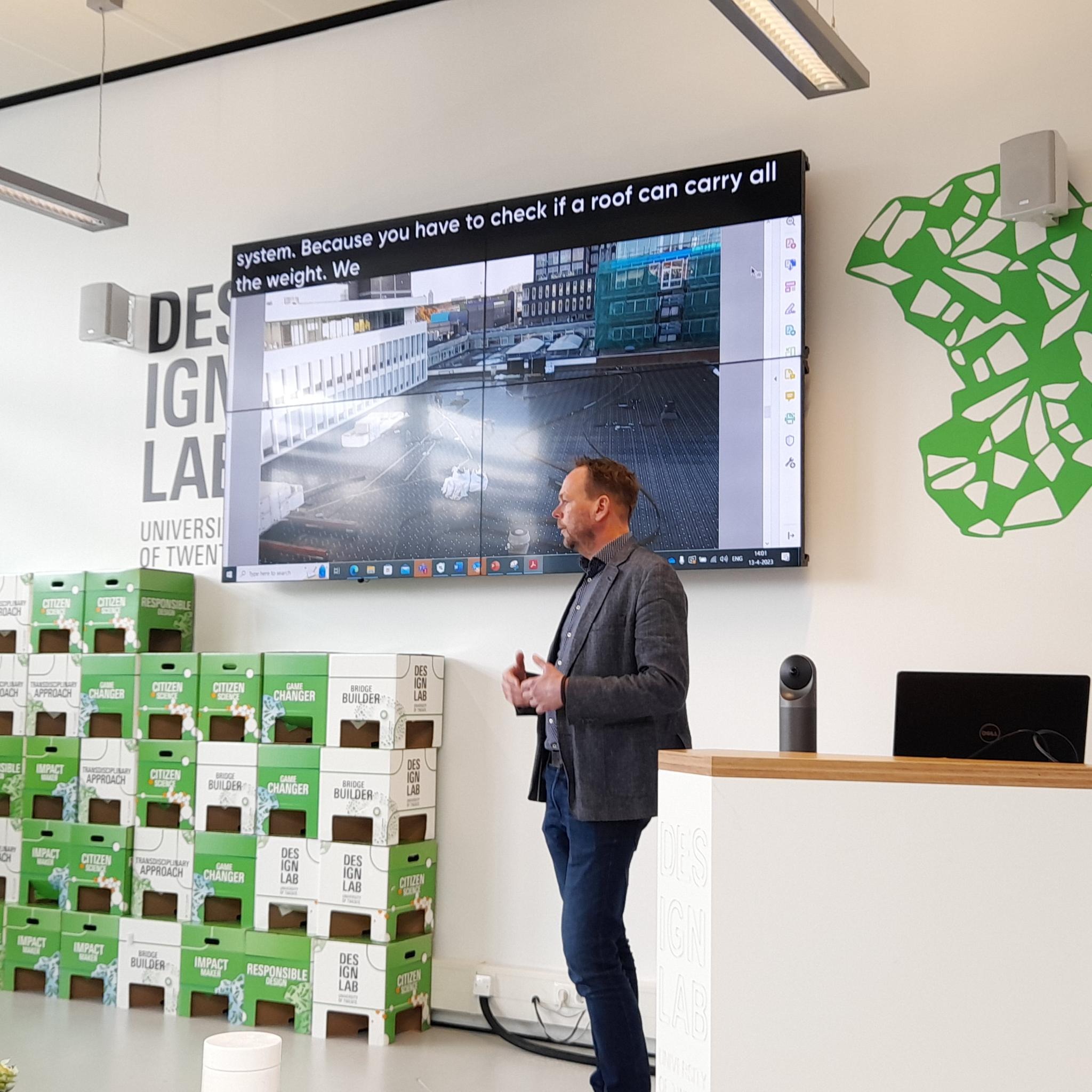
Workshop 'Cities to Nature'

Today we held our workshop, Cities to Nature, announced earlier on the UT website and Facebook. As mentioned in a previous post, the VU Amsterdam and UTwente have co-organized this workshop as part of the funding received for our joint program titled 'Towards climate-proof cities with innovative blue-green infrastructures'. 

The workshop included case study descriptions by first of all myself, on the LILa project and its goals to measure green roof performance; Michiel van de Bunt and Jacques Matijssen from Zinco and Solar Freezer; Tom Lentferts from Wavin; and Aurelio Wijnands from Green Panels.


We had students presenting their work related to this project: Ella Farmer on LCA review of green roofs and walls; Koen Vogel and Sil Dijkman on a blue green roof demonstrator; and Leon Peters on the possibilities of Virtual Reality for blue green roofs. 


Aside from presentations, this workshop specifically aimed at giving participants the opportunity to interact with each other. Our participants included several companies, municipality Enschede, a housing corporation, a nature organization, students and researchers. These participants were approached through the help of Het Groene Brein, an organization specialized in connecting scientists with sustainable and circular stakeholders. This paid off well for everyone involved. Multiple participants commented it was an excellent chance to really discuss blue green infrastructure developments in detail and loved to have the chance to talk with stakeholders from these diverse backgrounds. Other feedback from professionals in the field even included 'cool' and 'awesome', and most participants wanted another meeting to repeat what we experienced today, and to stay in touch with other participants.

For this we have good news. We have gotten extended funding for this project for the coming year, and both the VU and UT are expanding the project team members to jointly continue our research on blue green roofs. Our next workshop is being planned in October 2023 at the VU Amsterdam, where hopefully we can visit some of the blue green roofs already installed. Hope to see you there!

Monday, February 6, 2023

Week of the circular economy

6-11 February is the Dutch week of the circular economy. This is related to our LILa-GI as we attempt to make our design as circular as possible. Did you know that life cycle assessments of green roofs show using recycled material leads to less emissions over the life time of green roofs? More results on this to follow at our workshop in April.

Friday, January 27, 2023

Abstract for Ecocity World Summit 2023

Our collaborative abstract for the Ecocity World Summit 2023 conference is titled "A review of life cycle assessment (LCA) studies on green roofs and walls".

Green infrastructure (GI) is often presented as a promising measure to help reduce climate change pressures in dense urban areas. This benefit, combined with the fact that GI involves increased biodiversity leads to it being seen as a sustainable measure. However, few studies quantify GI’s water and energy impacts, thereby obscuring how environmentally friendly such infrastructure can be. To elucidate the known results so far regarding the environmental impacts related to energy and water use, such as climate change or freshwater scarcity, a systematic review was performed.

Scopus was used to gather studies for an in-depth analysis of life cycle assessment (LCA) studies with a focus on green roofs and walls and energy and water use related impacts. Project details were analyzed when available, specifically for the precise types of green infrastructure applied, the local climate circumstances, the applied construction materials and plant species, the building type and specifics, and the intended climate change adaptation benefits. The characteristics of the LCA studies analyzed include the type of software and databases used, the system boundaries and functional unit applied, the cut-off criteria, water and energy related environmental impact categories, main conclusions, and research gaps.

The analysis of the results can be used as concrete recommendation for designing and constructing a long-term monitoring setup of green roofs and green walls at the University Twente, the Netherlands, as part of the Living Innovation Lab (LILa), with respect to the question of what is the most environmentally friendly way to design green roofs and green walls.

This abstract is submitted by University Twente researchers Karina Vink, Joao Santos, Markus Berger, Peter Chemweno, and Vrije Universiteit Amsterdam researcher Nicolien van der Grijp. 


Monday, January 2, 2023

What is the Living Innovation Lab?

 What is the LILa?

The Living Innovation Lab (LILa) is a joint initiative of the faculty of Engineering Technology (ET) and Geo-Information Science and Earth Observation (ITC) at University Twente, the Netherlands. Its goals:
- provide a semi-controlled setting for observation, monitoring, and experimentation
- support training and education for vocational schools, university students, and practitioners
- connect with local communities and industrial partners
Green Infrastructure is just one among over a dozen of research projects taking place. Click here for more information on the other research projects at this site.

Green Infrastructure
In the initial stage, three different types of green roofs are in development, along with three different types of green walls. The green roofs include extensive and intensive green roofs, and blue-green roofs. The green walls consist of free climbing soil bound plants, scaffolding climbing plants, and wall forming modular vegetation. Both green roofs and green walls are compared to a section of building without green infrastructure, to assess performance comparatively. A later stage includes the transformation of parking places to have permeable pavement and underground water storage adjacent to the LILa site. 

Climate Change
Green Infrastructure can help to reduce the imapacts of climate change in two ways. One way is adaptation, to change our environment and increase resilience. An example of this is planting trees that increasee shade in hot summer months. The second way is mitigation, to reduce the levels of green house gases in the atmosphere. An example of this is that trees use CO2 to grow and thereby remove some from the air.
Most importantly, building green infrastructure can only be truly sustainable and thereby not add to greenhouse gases or other excessive consumption by paying attention to the entire life cycle, from production to the end of life, of the materials involved.

What are the research questions?
Two main research questions are answered through LILa - GI. The first concerns the quantified energy and water tradeoffs of GI.
To answer this we aim to quantify the potential climate resilience benefits:
- reduced urban floods and runoff peaks
- reduced heating/cooling
- carbon sequestration
and quantify the potential tradeoffs:
- CO2 emissions during production, maintenance (for irrigation and pumping), and end of life
- required irrigation and stored precipitation
all through continuous monitoring and modeling.

The second research question is how a supposedly sustainable measure as GI can be constructed in a most sustainable way, that is to say, not just be sustainable during its use phase, but also during material selection, construction, and end-of-life. To answer this, both Life Cycle Analysis modeling and intense cooperation with designers and construction companies are implemented.

Visiting

Do you want to visit the LILa - GI site with a small group? Send an email expressing your interest.

Location at University Twente
You can visit the LILa at University Twente. It is located at the road De Achterhorst, between buildings 31 (Windpark) and 32 (BMC) on the campusmap. Public transportation and access routes can be found in this campusmap.

Current impression
The LILa site is still in the development phase. At the moment you can see poles and signs where the various studies are planned to be constructed. 


UT Field Lab Roof update July - September 2026

These months we had some extremes in terms of drought but also in terms of short intense rainfall, and it remains rather obvious visually wh...