Showing posts with label circularity. Show all posts

Sunday, October 5, 2025

Energy Efficiency Day

 This Sunday is Energy Efficiency Day. What does it mean and what can you do? 

"On October 5th, Energy Efficiency Day is an initiative that emerged in 1998, with the idea to raise awareness about energy consumption. What is energy efficiency? It means using less energy to do a specific task. In other words, it's about finding ways to avoid energy waste."

In Europe this is an important day for the parliament and policymakers to come together and discuss future plans.  "EE Day will feature a high-level policy roundtable bringing together policymakers, business leaders, and civil society representatives to explore the role of energy efficiency in strengthening Europe’s competitiveness and building a more secure and sustainable energy system." 

But on a more local level you can find actionable suggestions here. Increasing energy efficiency can be achieved by using more efficient devices and machines, insulating buildings, having a programmable thermostat that is only active when people use the building, cleaning and maintaining equipment, turning devices off when they are not used, using or blocking out the sun according to the season. 

How do we apply this concept at our LILa project? Our dataloggers are solar powered and automatically stop charging their internal batteries once full, thus preventing use and elongating the lifetime. The building we work with has airconditioning, but can also use windows for fresh air. As for equipment and insulation, we still need to check the status once the new occupants are decided. There is a tradeoff between using older equipment to the end of its lifetime and upgrading to more energy efficient equipment that still needs to be determined. 

Archives | The EI Group 

Monday, November 18, 2024

European week for waste reduction

This entire week from 16-24 November it is the European week for waste reduction, which also has a Dutch website.The aim is to encourage all Europeans make others aware of renewable sources and recycling options. 

While the one entry listed for the Netherlands is a clothing swap in The Hague, our own campus also regularly has clothing swaps, the latest during the sustainability week. 

As for awareness, I still think the best publication with options along the entire supply chain was: Circular Economy 3.0 - Solving confusion around new conceptions of circularity by synthesising and re-organising the 3R's concept into a 10R hierarchy.This shows the following ten options, and the first 4 (R0-R3) and R7 are specifically for consumers to consider, and can really help with rethinking choices for circularity in our own lives.

R0 = Refuse

R1 = Reduce

R2 = Resell, Reuse

R3 = Repair

R4 = Refurbish

R5 = Remanufacture

R6 = Re-purpose

R7 = Recycle materials

R8 = Recover energy

R9 = Re-mine


Monday, October 14, 2024

National energy week

The week of 14 to 20 October is national energy week in the Netherlands. This is aimed at government and business stakeholders and has 4 different trade shows throughout the country on the topic, and promotes the energy transition. 

Our Dutch climate agreement has as aim to cut CO2 emissions in half by 2030 (compared to 1990) by 5 goals:

  • Built environment: by 2050 7 million houses and 1 million buildings should be disconnected from gas
  • Mobility (traffic and transport): by 2050 there are no emissions
  • Industry: circular by 2050 and close to no GHG
  • Agriculture and land use: climate neutral by 2050
  • Electricity: by 2030 all electricity comes from renewable sources

A lot of this agreement focuses on energy related technologies. But there are still technologies costing energy that we don't think about too much in our daily lives. Starting from using less, here are some things we could consider.

Email and attachments: 20 mails a day (no attachments) is the equivalent of driving 1000 km a year. The mails are stored on a server and only if you delete them from your trash, will they stop costing server space and thereby energy (and water for cooling). A 1MB attachment in an email supposedly costs 15g CO2 emissions. So it is better to send a link to a shared file than the attachment itself. As example, if you would send 25 MB per week, you could save over 19 kg.

Email signatures: "An average email signature that features a profile picture and company logo" could be 0.08 MB, which doesn't seem a lot. Depending on how many mails you send, it could add up quickly. According to this link it could become e.g. 10 emails per day * 1.2 grams CO2 * 255 working days = over 3 kg of CO2 emissions. So it is good to reconsider if you need to send the company logo to everyone you mail, or any other text/links in every mail. Does the recipient already know you? Best leave it out.

Saving files on a drive/dropbbox/other online server/cloud: Again, the data centers require energy and water to maintain access to your files. The larger the files, the more resources required. While it is not much, cumulative it becomes a lot and it is good practice to remove files you no longer need, also for security reasons. In 2021 3.7 TWh electricity was provided to data centers, 3.3% of total Dutch electricity use. 

According to milieucentraal an average Dutch household emits 18,500 kg CO2 per year. Yes, it is not much to save around 1/1000th of your annual emissions, or 1/500th, assuming there are 2 people in the household that might reduce these emissions. But times all households in the Netherlands, this becomes a much larger share once more. As these are mostly automated steps that cost little time to set up or adjust, it is an easy change to implement, and all small bits help.


Friday, November 10, 2023

National Environmental Day

Today is National Environmental Day. This year the Network of Environmental Professionals who organizes the event has selected the theme of Planetary Justice.

They write: Planetary Justice is an extension of climate justice, in that a just distribution of costs and benefits, historical responsibility and intergenerational justice is sought. This is a challenging concept that needs further reflection and discussion. Not only as a moral concept, but also in a practical sense. What you do here in the Netherlands as a consumer or environmental professional affects the other side of the earth. If you make policy on energy transition or fail to take action, it has consequences for the extraction of materials in countries such as Chilli, China, Congo, and Indonesia. The emissions we cause in the Netherlands or elsewhere increase the likelihood of tipping points, which threaten nature and people worldwide. Planetary justice asks us questions about virtually every habit, choice or intervention not just nationally, but globally. It has in its lens the Earth system as a whole, as well as people, animals and ecosystems.

This is why we seek to develop both green infrastructure and measuring systems, from their entire life cycle, as well as research practices, that have the least environmental impact. More information on the planetary justice framework in general can be found in this publication.

Friday, October 13, 2023

Green Panel reconstruction

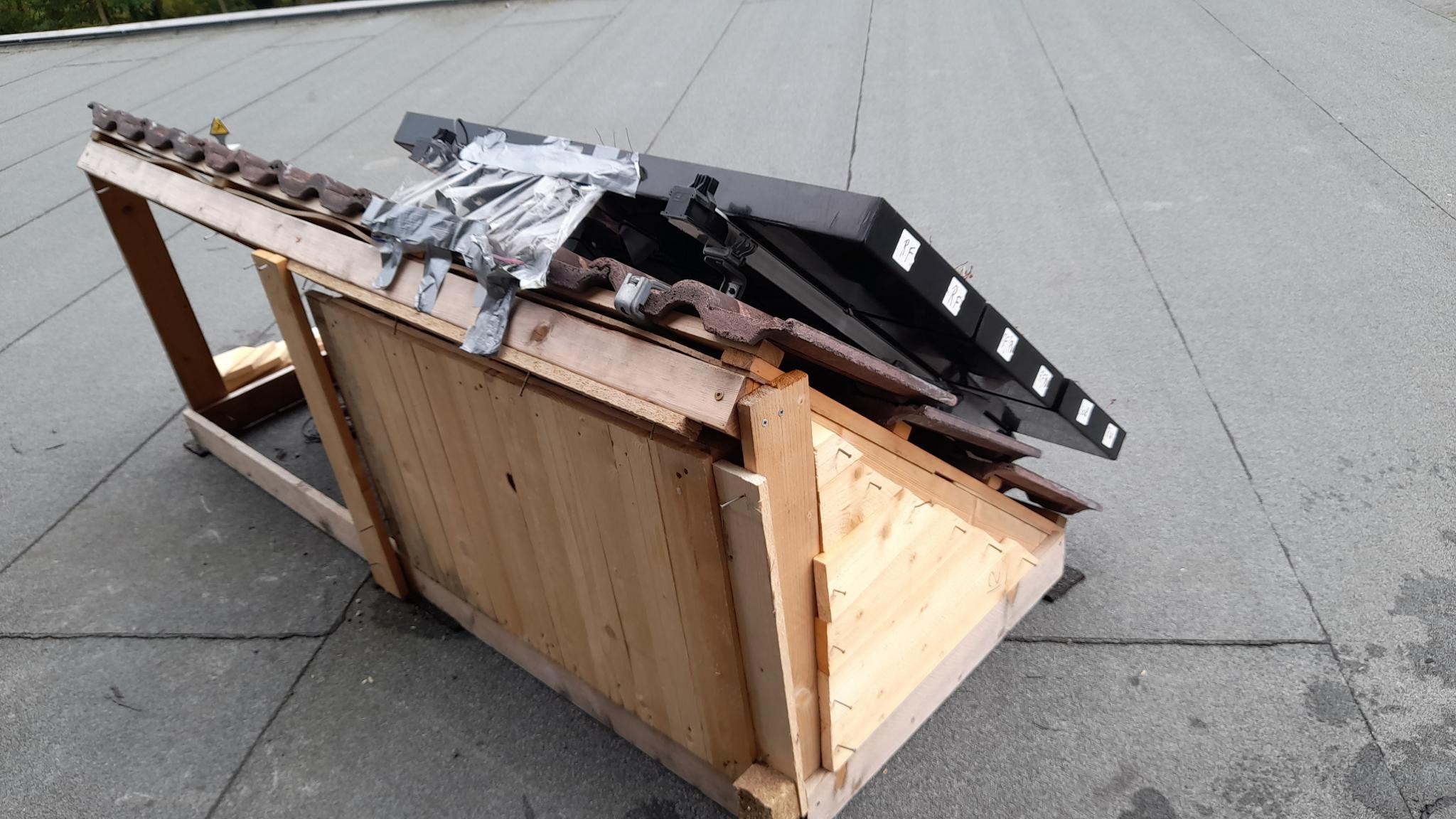
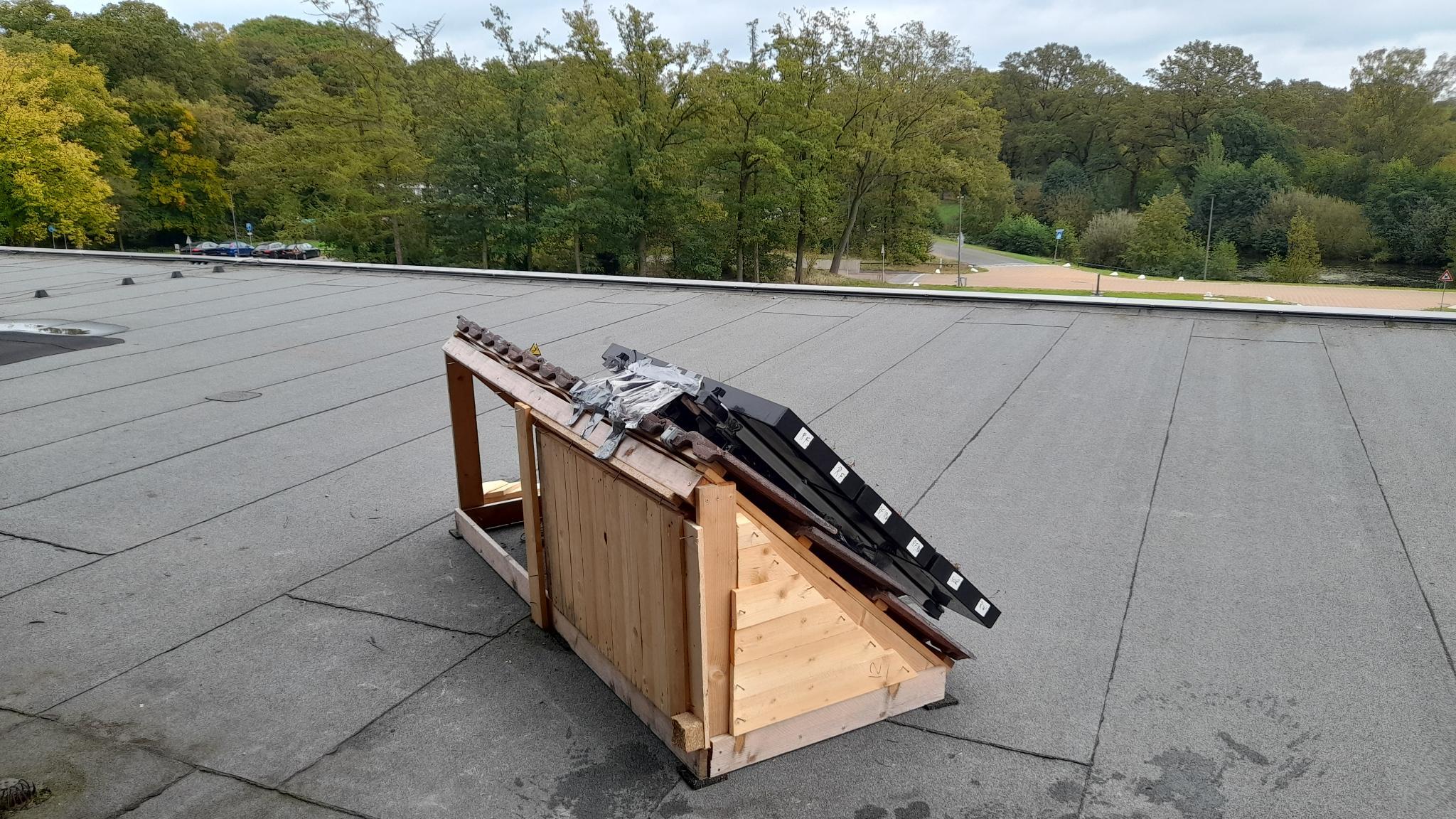
After obtaining permission we now have our fake roof on the roof enclosed against the elements. This was again performed by using only waste wood gathered from the UT's various buildings, inherited nails, available handheld tools (no electricity), and breaking an axe. The result is two permanently enclosed sides, and looking from the back, a sliding left panel and a removable right panel to access the batteries and sensors behind. 

After a storm this week the left hand side panels needed some touching up but now the structure is solid. We now hope to get a higher difference in temperature between the top and bottom of the roof tiles. We still hope to replace the plastic tape and covers with more durable official sensebox covers.


Thursday, September 7, 2023

National Resources Day

7 September is National Resources Day. While there is not a lot of information to be found on this annually recurring event for 2023, issuemakers.nl describes it as follows.

"With the National Raw Materials Day we want to draw attention to the task and new role of governments in the field of reuse on upgrading residual streams. The government is an important player here because it:

  •     is the provider, producer and owner of those residual streams, such as biomass, old asphalt and old street furniture.
  •     is the driver for innovation and implementation through tendering and procurement
  •     can be the buyer of the new products from these raw materials

We are talking about millions of tons of waste. That is why governments play an important role in working together to make the Netherlands circular 2050."

Our government has recently enforced a new price on plastic packaging. This helps people think about all the packaging being used at what it could be repurposed for. For our green roof/wall project, repurposed plastic might be used for:

-packaging of equipment, transport cases for equipment

-sensor exteriors to protect from weather elements

-crates to store water for blue green roofs

-attachments of materials/layers to existing roofs/walls in the form of clamps or other ring/clasping structures

-signposts and signs to educate visitors

-chairs and desks, bookcases in meeting rooms

With this in mind, we can rethink the design and eventual orders for materials and equipment for this projejct and ask suppliers if they have any repurposed plastics or other materials to offer.

Friday, July 28, 2023

World Nature Conservation Day

The 28th of July is World Conservation Day, "with the objective of increasing awareness about and protecting the natural resources that the Earth is bestowed with. It is necessary to understand what ‘Sustainability’ truly means and also it is important to inculcate environment-friendly habits to lead a Green Lifestyle.  Some simple practices that can make your lifestyle green if followed in daily life are –
  •     Help in conservation activities in your area / surrounding natural areas.
  •     Participate in the environment awareness activities.
  •     Wise use of resources like paper, fuel etc.
  •     Efficient use of water & energy at home.
  •     Try to avoid use of plastic bags while shopping.
  •     Be a responsible tourist by practicing eco-tourism.
  •     Avoid littering around during travel.
  •     Appreciate nature and keep vigilance on surrounding nature destruction, inform concerned authorities."

For this purpose I want to direct you to the workshop we have set up at the University Twente called Your Sustainability Journey. This workshop includes examples of actions you might already be doing, or could do, to have a sustainable life. The website has direct links to local shops, locations, and organizations you can use to have a more sustainable lifestyle. It also shows detailed calculations of each action and how much of a carbon impact it has. You can request a workshop on the website for yourself or your team or company, and even use it as further discussion on what sustainable goals you have for your department and how you can work together to reach these. 

We take what we learned during this workshop into our project work and try to implement sustainable practices where we can.


Friday, July 21, 2023

Visit to Groendak part 2: sloped roofs

Back to reporting on our visit to groendak, we also received a lot of information about the options for sloped roofs.

For sloped roofs, groendak offers a standard option up to an angle of 25-30 degrees. The main issue is to prevent materials from sliding off the roof, and there are different techniques for this. Currently there are experiments with Velcro (Belgium) and glue (Netherlands) as alternative materials to prevent slippage. The standard sloped green roof has the same materials as a flat green roof, with these exceptions.

  • Soil and substrate - Lava rocks with extra ground layer to prevent sliding
  • Filtration layer - special filter with tubes integrated in the fleece (made in Belgium)
  • Drainage layer - Rubber plastic EDPM (made in the Netherlands)


For higher degree slopes up to 65 degrees, different material is used.

  •     Vegetation/substrate mat - Sedum, this can grow up to a slope of 65 degrees. The plant mat is attached to the plastic grid below by thin sticks.
  •     Filtration layer - Filtration fleece, water can pass but particles are caught (Belgium)
  •     Drainage layer - plastic crate HDPE with metal hooks to prevent sliding, placed every 1.5m
  •     Protective layer - Fleece (Belgium)
  •     Roof

There is also a groendakpan - a green roof tile. This replaces the standard roof tiles and has a small space for plants to grow in and water to be retained. The normal elements of the roof are beneath the groendakpan, no additional materials are required. The water is drained into the next tile below and then in the roof gutter. Fleece is used inside the tile to pull the water up in the pan. The height of the pan is low compared to a sloped green roof. 

To prevent drought on a sloped roof, an irrigation system with tubes and holes to feed the top of sloped green roofs is developed.

As for performance measurements, flat roof performance has been tested when it comes to temperatures, water retention, and soil moisture content, as compared to a normal roof. For sloped roofs, the performance of the groendakpan has been tested in three locations. None of the green roof types have been subjected to a Life Cycle Assessment. This leaves room for many improvements in the production process.


Friday, June 23, 2023

Making a roof on a roof

Today was the start of construction for our first Green Panel performance test. During this phase the fake roof (sloped) was made on top of the existing roof (flat) of our engineering technology faculty of University Twente, on the Horst building.


The fake roof is angled towards the SE where we expect to get the most sunlight, and sloped at and angle of 45 degrees. Additional wood was needed to ensure sufficient support for the sloped angle of the setup, which we obtained from the building's waste center to recycle. This week the roof tiles are added along with solar panel guiding rails. Next week it's time to fit the Green Panels on top and place sensors.

Monday, June 5, 2023

World Environment Day

Today is World Environment Day. This year the goal is 'Beat Plastic Pollution'. How can we apply this in our research project? We follow these steps, based on this publication on 'Solving confusion around new conceptions of circularity by synthesising and re-organising the 3R's concept into a 10R hierarchy'.

The 10R hierarchy: R0 = Refuse R1 = Reduce R2 = Resell, Reuse R3 = Repair R4 = Refurbish R5 = Remanufacture R6 = Re-purpose R7 = Recycle materials R8 = Recover energy R9 = Re-mine

0. Refuse. Avoid using plastics. What you don't use, won't pollute.

1. Reduce. We assess whether we really need to purchase/use plastics in every material involved, and ask producers to not use additional plastic packaging before sending products if possible.

2. Resell, reuse. Starting from applying reused or second hand products, the materials used during the project, once they reach their end of life, might be resold.   

3. Repair. Nothing is broken yet but the intention is to not by new if a product fails during its lifetime, but to repair it where possible. This extends the life of used plastics.

4. Refurbish. After the project finishes, if someone else can use the materials, sensors, or green infrastructure for another purpose, this should be made possible. 

5. Re-manufacture. Similar to above.

6. Re-purpose. Similar to above.

7. Recycle materials. When plastic cannot be safely reused or repurposed, it is recycled in the correct waste stream. University Twente has separate trash cans for smaller plastics for this purpose, all over campus.

8. Recover energy. This is part of the municipality Enschede's waste management scheme.

9. Re-mine. This concerns landfills and is also beyond the scope of this project, but part of waste treatment. 


Bonus: Help solve the problems already caused. During the well-being weeks, you can sign up for a lunch walk (free lunch!) and help to pick garbage during the walk. See the link below to sign up.


TUE - Lunchwalk "Care for the environment"

Date: 27 June 2023 
Time: Start between 12:00 and 12:30  
Location: Start HEAD 

During these Well-Being Weeks, every lunch walk has its own theme! The last lunch walk has the theme “Care for the environment”. Since the theme of these well-being weeks is “Together we care” we would like to encourage you to talk about your opinion regarding different topics. In the previous Lunch walks, you were able to reflect on your own well-being and that of others. This time, it is possible to do something about the well-being of the environment. At the start of the lunch walk, you will receive a garbage bag and garbage picker to collect garbage during your walk and clean the environment. At the end of the walk, there will be a lunch waiting for you!

Friday, June 2, 2023

Visit to Groendak

Today a group of students working on the Green Panels and myself visited Groendak.nl in Scherpenzeel. We received a lot of detailed information about the materials applied in different types of green roofs, which can be used for developing our prototypes and for considerations of the entire life cycle. 

Flat roof, from top to bottom:

  • Local vegetation - Heath, Dune grass, Peat grass. Sedum also possible.
  • Soil - Potting soil (Netherlands)
  • Substrate - Lava rocks, aerated by holes so water can pass through and nutrition is caught (Germany, Eiffel area)
  • Filtration layer - Filtration fleece, water can pass but particles are caught (Belgium)
  • Drainage layer - plastic, water can go underneath or stored inside meaning plants are irrigated for 6 to 8 weeks (Germany)
  • Protective layer - Fleece (Belgium)
  • Roof
  • The net for edges to prevent wind blowing the layers off the roof is made from recycled plastic (Netherlands)

These materials work well in all climates. The plant species will not perform well in all climates. We also received information for sloped roofs and green tiles, and performance measurements, which I will save for a later post.


Monday, February 6, 2023

Week of the circular economy

6-11 February is the Dutch week of the circular economy. This is related to our LILa-GI as we attempt to make our design as circular as possible. Did you know that life cycle assessments of green roofs show using recycled material leads to less emissions over the life time of green roofs? More results on this to follow at our workshop in April.

Monday, January 2, 2023

What is the Living Innovation Lab?

 What is the LILa?

The Living Innovation Lab (LILa) is a joint initiative of the faculty of Engineering Technology (ET) and Geo-Information Science and Earth Observation (ITC) at University Twente, the Netherlands. Its goals:
- provide a semi-controlled setting for observation, monitoring, and experimentation
- support training and education for vocational schools, university students, and practitioners
- connect with local communities and industrial partners
Green Infrastructure is just one among over a dozen of research projects taking place. Click here for more information on the other research projects at this site.

Green Infrastructure
In the initial stage, three different types of green roofs are in development, along with three different types of green walls. The green roofs include extensive and intensive green roofs, and blue-green roofs. The green walls consist of free climbing soil bound plants, scaffolding climbing plants, and wall forming modular vegetation. Both green roofs and green walls are compared to a section of building without green infrastructure, to assess performance comparatively. A later stage includes the transformation of parking places to have permeable pavement and underground water storage adjacent to the LILa site. 

Climate Change
Green Infrastructure can help to reduce the imapacts of climate change in two ways. One way is adaptation, to change our environment and increase resilience. An example of this is planting trees that increasee shade in hot summer months. The second way is mitigation, to reduce the levels of green house gases in the atmosphere. An example of this is that trees use CO2 to grow and thereby remove some from the air.
Most importantly, building green infrastructure can only be truly sustainable and thereby not add to greenhouse gases or other excessive consumption by paying attention to the entire life cycle, from production to the end of life, of the materials involved.

What are the research questions?
Two main research questions are answered through LILa - GI. The first concerns the quantified energy and water tradeoffs of GI.
To answer this we aim to quantify the potential climate resilience benefits:
- reduced urban floods and runoff peaks
- reduced heating/cooling
- carbon sequestration
and quantify the potential tradeoffs:
- CO2 emissions during production, maintenance (for irrigation and pumping), and end of life
- required irrigation and stored precipitation
all through continuous monitoring and modeling.

The second research question is how a supposedly sustainable measure as GI can be constructed in a most sustainable way, that is to say, not just be sustainable during its use phase, but also during material selection, construction, and end-of-life. To answer this, both Life Cycle Analysis modeling and intense cooperation with designers and construction companies are implemented.

Visiting

Do you want to visit the LILa - GI site with a small group? Send an email expressing your interest.

Location at University Twente
You can visit the LILa at University Twente. It is located at the road De Achterhorst, between buildings 31 (Windpark) and 32 (BMC) on the campusmap. Public transportation and access routes can be found in this campusmap.

Current impression
The LILa site is still in the development phase. At the moment you can see poles and signs where the various studies are planned to be constructed. 


Insights from "A Dutch – U.S. Dialogue on Governance Capacity for Extreme Heat" workshop

On 4 November 2026 (Wednesday), Dutch and U.S. participants convened for an in-person , full - day workshop to discuss the issues they ...